

Manifest V3 ad blockers are the only kind Chrome runs today. Manifest V3 is the set of rules Chrome gives extensions, and the switch to it changed how blockers decide what to block. The change was loudly debated, and a lot of what was said about it was either exaggerated or out of date by the time it took effect. This is what actually changed, and what it means when you browse.
What changed
Under the old model, Manifest V2, a blocker could inspect every request a page made with its own code and decide on the spot whether to let it through. Under Manifest V3, the blocker hands the browser a set of rules in advance, and the browser applies them itself through the declarativeNetRequest API. The extension no longer sees each request as it happens.
Google phased the old model out over 2025. According to its Manifest V2 support timeline, old extensions were first switched off by default, then from Chrome 138 they could no longer be turned back on, and the timeline set 31 August 2026 as the date for removing the remaining ones from the Chrome Web Store. Edge and other Chromium browsers share the same platform.
What still works well
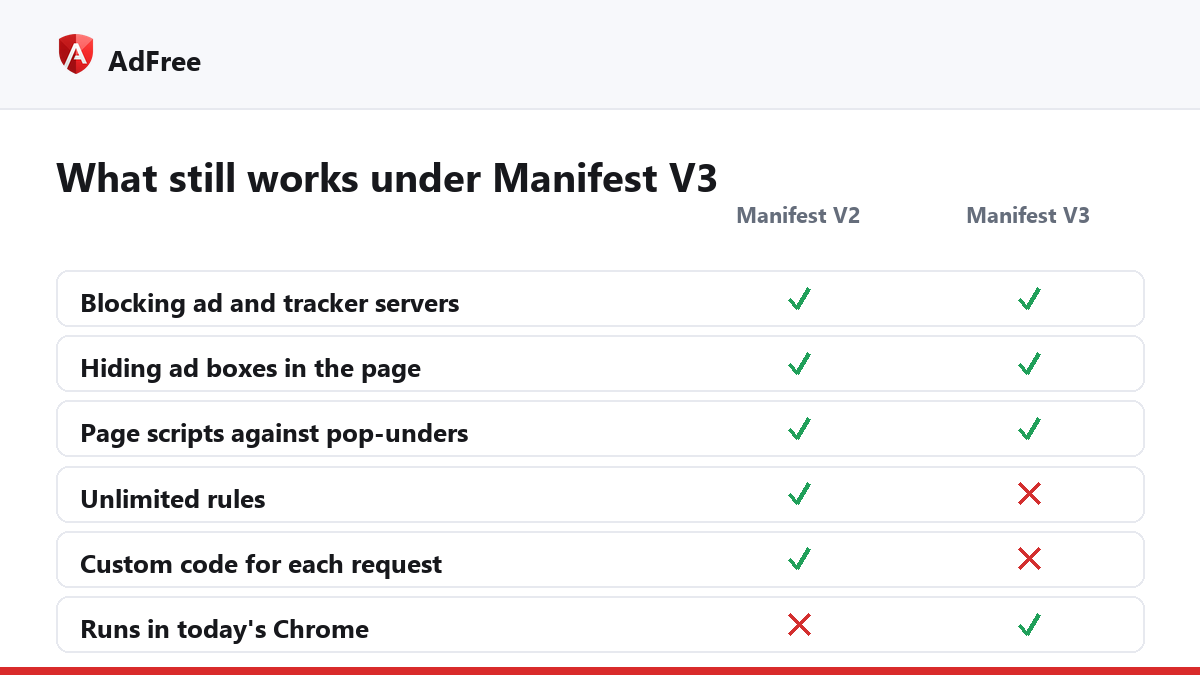
- Blocking ad and tracker servers. This is most of an ad blocker’s work, and the browser does it natively and quickly.
- Hiding ad boxes. Element hiding runs in the page and was not affected.
- Page scripts. Scripts that stop pop-unders or remove ad data from a video player still run inside the page.
- Per-site allowing. Rules can exclude sites, so “allow on this site” still works.
What got harder for manifest v3 ad blockers
Three things, all real but smaller than the early headlines suggested:
- Rule limits. Chrome guarantees each extension 30,000 rules in the lists it ships, with more available from a pool shared between extensions, and allows up to 30,000 rules added at run time. Regular-expression rules are capped at 1,000. Large blockers have to choose which rules matter most.
- Slower list updates. Lists that ship inside an extension change when the extension does, and every update passes through store review. A new ad network can get through for a few days.
- No custom logic per request. A rule matches or it does not. Tricks that depended on reasoning about each request in code are no longer possible in Chrome.
| Area | Manifest V2 | Manifest V3 |
|---|---|---|
| Who decides on a request | The extension’s code | The browser, from the extension’s rules |
| Speed of matching | Depends on the extension | Native and indexed |
| Number of rules | No fixed limit | Limited, with a guaranteed minimum |
| List updates | Often downloaded directly | Mostly through extension updates |
| Element hiding and page scripts | Yes | Yes |
What it means for you
On most sites, nothing visible. Ads from known networks are blocked as before, and pages often load slightly faster because matching happens inside the browser. Differences show up at the edges: on sites that change their ad setup every week, and on YouTube, where any blocker is in a constant back-and-forth with the platform.
AdFree was built on Manifest V3. Its blocklists ship inside the extension and are loaded as rules when it starts; that is also how it can switch a list off or allow one site without a reload of the extension. The pop-up guard and the YouTube filter are page scripts, so the change did not affect them. For more on the lists themselves, see ad blocker filter lists explained, and for the bigger picture, how ad blockers work.
Frequently asked questions
Are Manifest V3 ad blockers worse?
For everyday browsing, the difference is small. They are less flexible on the hardest cases and slower to react to new ad networks.
My old ad blocker stopped working. Why?
If it was never updated to Manifest V3, Chrome switched it off. You will find it disabled on chrome://extensions. Replace it with a current one.
Does Firefox use Manifest V3 too?
Firefox supports Manifest V3, but Mozilla has said it will keep supporting the older way of blocking requests alongside it, with no announced end date.
Manifest V3 ad blockers trade some flexibility for speed and a smaller attack surface. For most people the change is invisible; what matters more is whether the blocker’s rules are kept up to date.
Stop paying attention to ads you never asked for
No account. No tracking. No cost.